
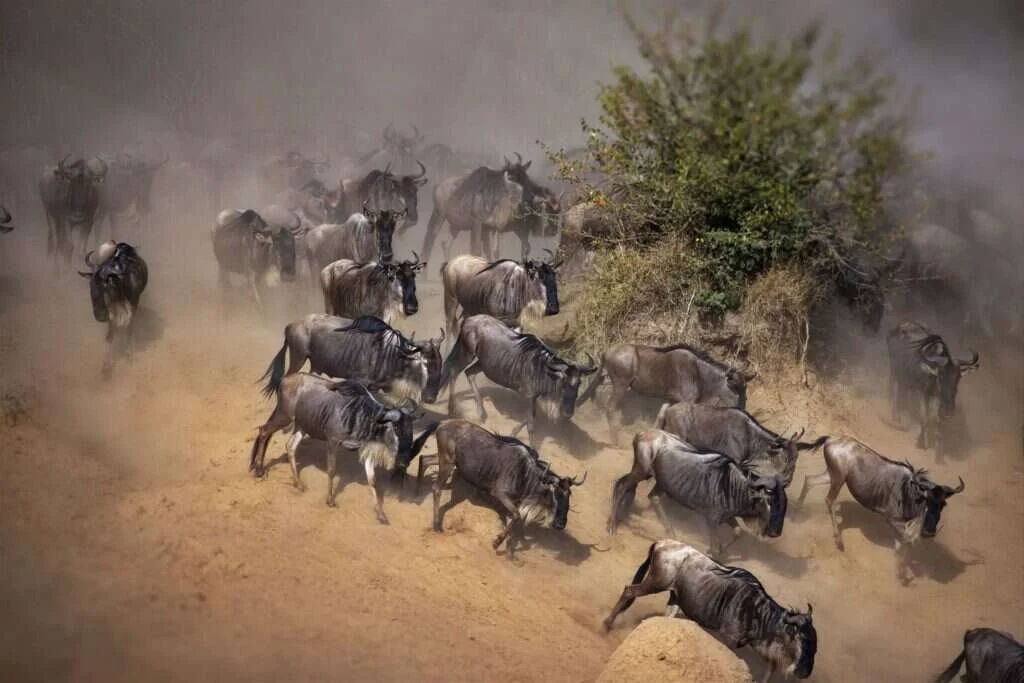
When planning a Serengeti Great Migration safari, the most useful question is often not “Which month is best?” but “Where should we sleep during the month we can travel?” A beautiful camp in the wrong part of this vast ecosystem may leave you with long drives to the wildlife areas you hoped to explore.
This guide focuses on that accommodation decision. It complements the site’s existing migration articles by explaining how to evaluate camp locations, allocate nights and recognise the limits of a seasonal forecast.
What is the Serengeti Great Migration?
The migration is a recurring movement of wildebeest and accompanying grazing animals through the Serengeti–Mara ecosystem. Rainfall and access to grazing influence where groups gather and move. Herds may spread across different areas, split into smaller groups or change direction. There is no single line of animals that can be followed on a fixed timetable.
River crossings are only one part of this cycle. Calving, grazing, predator activity and the movement of long columns across open country can be equally compelling. Read TANAPA’s migration overview for the wider ecological context.
Use a seasonal map, not a sighting guarantee
A seasonal description helps narrow the search for accommodation. It cannot identify the exact position of the herds on a future date. Ask your operator to explain both the likely wildlife area and the alternative experiences available if conditions differ from expectations.
Map the camp, the airstrip or road entry point, and the intended game-drive area. A familiar region name can cover a large distance. Knowing the camp’s actual location is more helpful than a label such as “migration lodge”.
January to March: southern plains and Ndutu
The southern Serengeti and Ndutu area are commonly associated with calving-season journeys. When conditions favour these grasslands, they can provide broad views of grazing herds and young animals. The timing and concentration vary with the rains.
For this period, investigate camps serving the southern wildlife areas rather than automatically booking far north. Ndutu also spans a wider conservation landscape, so check which areas and activities your itinerary includes and which permissions apply. Ask whether the camp remains in that location for your exact dates.
April to June: planning for movement and changing conditions
During these months, groups may move away from southern grazing areas towards central and western parts of the ecosystem. Rain can affect both the wildlife distribution and the practicality of some tracks. A sensible proposal explains why a particular base has been chosen for the stage of the season.
This is a useful time to discuss flexibility. That might mean a central base with several possible game-drive directions, or a split stay when the route and available days support it. Flexibility does not mean moving camp every evening or assuming accommodation can always be changed at the last minute.
July to October: the northern Serengeti and possible crossings
Northern Serengeti itineraries are often considered during the broader river-crossing season. However, booking a northern camp does not guarantee a crossing, a particular riverbank location or a herd encounter on demand.
Consider several nights in the relevant region so your guide can balance patient observation with ordinary game drives. A full day spent waiting at a river may not suit every traveller. Families and photographers may have different priorities; discuss those before committing to an itinerary centred on prolonged waits.
November to December: choosing a base for the return
As grazing conditions change, herds may move towards eastern and southern areas. Short rains can influence the pace and direction. This transition calls for a carefully explained camp choice, particularly if your dates fall near the change between two commonly described seasons.
Ask what the operator expects for your dates, how recent the information is and what makes the proposed route worthwhile beyond the migration. A good answer recognises uncertainty rather than replacing it with confident promises.
Permanent lodge or seasonal tented camp?
A permanent lodge offers a fixed base. A seasonal camp operates in selected locations for defined periods; it does not move alongside your vehicle each morning. Confirm its operating dates and the location applicable to your booking.
Compare bathroom facilities, power arrangements, room layouts and the distance between tents. Luxury is not simply a solid building, and a tented camp is not automatically basic. Your comfort preferences should be considered alongside wildlife access.
How many nights should you allocate?
Three nights in one suitable area can provide a more settled experience than rushing through several regions in the same time. A longer stay can support a second base when there is a clear reason to move. Count travel time between those bases as part of the holiday.
Use the published eight-day northern Tanzania safari as a route reference, then ask for a seasonal adaptation. A general Serengeti itinerary is not automatically a dedicated migration itinerary. The Serengeti park page helps place the destination in your wider journey.
A practical camp-booking checklist
- Confirm the actual camp and location for your dates, not only its brand name.
- Ask how many full wildlife days remain after arrival and departure transfers.
- Check room configuration, cancellation terms and any flight baggage limits.
- Discuss how the guide balances migration searches with other wildlife viewing.
- Choose an itinerary you would still enjoy without a river crossing.
Responsible viewing matters at busy sightings. A vehicle should not pressure animals to cross or obstruct their route. Patience is part of the experience, not a reason to encourage disruptive driving.
Frequently asked questions
Can I book the exact date of a crossing?
No. Crossings depend on animal behaviour and environmental conditions. Accommodation gives access to an area, not a reservation for a wildlife event.
Is a longer safari always better?
Extra time helps only when the route uses it well. Our first-time safari planning guide explains how to distinguish wildlife days from transfer days.
Plan a migration safari around your dates
Share your available dates and whether your priority is calving, broad herd landscapes, photography or the possibility of river crossings. Altaika can explain the location choices behind a seasonal proposal.


